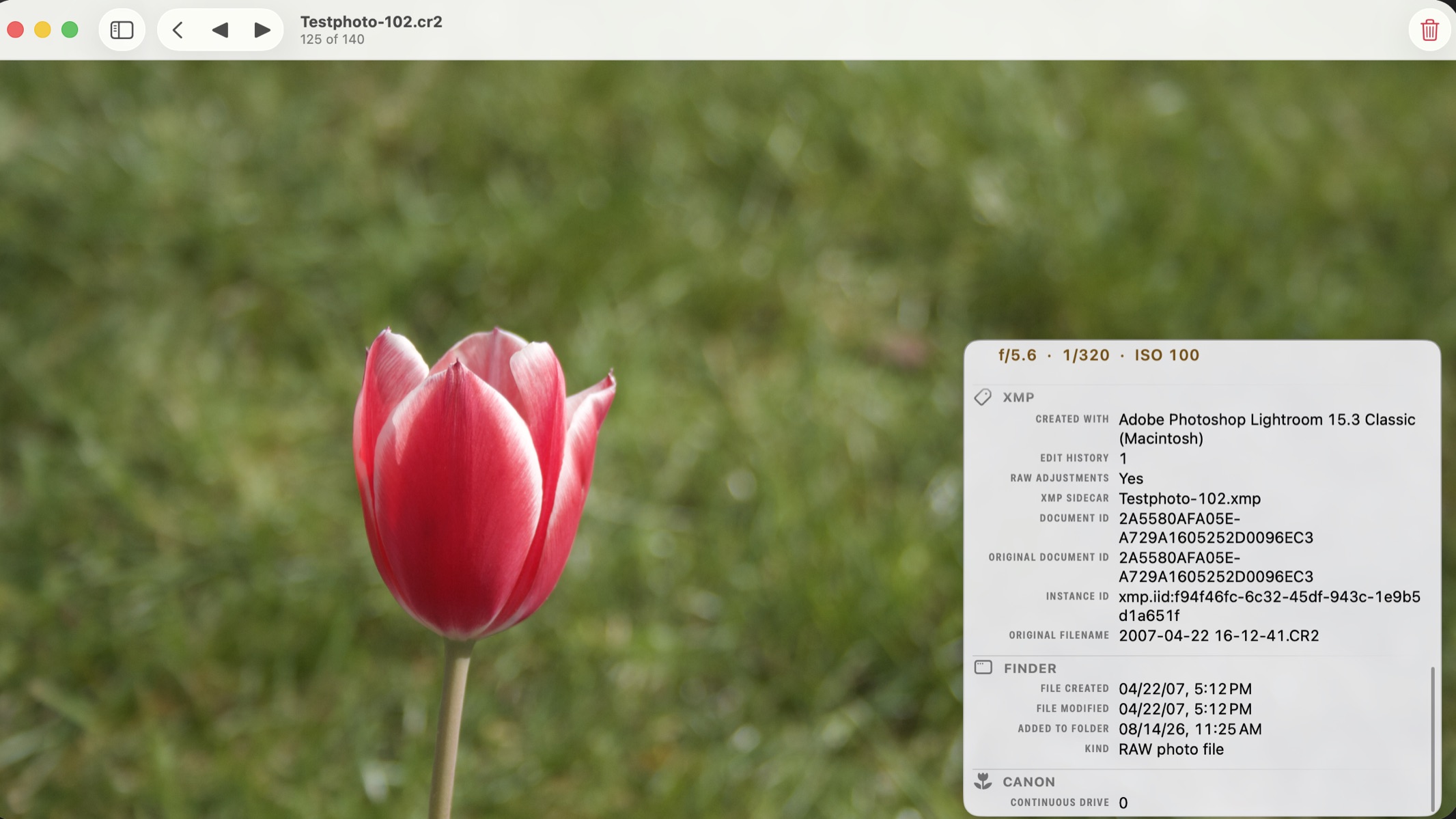
In a RAW workflow the original file is never rewritten, so everything you decide about a photo, the rating, the keywords, the rights, the develop settings, ends up in a second file next to it. That pair only works if it stays a pair. On a Mac, PhotoView opens the original from disk, finds the .xmp sidecar beside it, and shows both halves over the photo. Read-only, on your device.
App
Topic
Recent posts
Why I built PhotoView
An origin story. A film SLR in the late 80s, Lightroom since the 2006 beta, and a library that now lives on iPhone, iPad and Mac. What I wanted was simple: see a photo full screen and still read how it was made.
The right size for the Sudoku cells
A Sudoku is a square of 81 cells — almost the whole layout hangs on the question of how big one of them may be. Why the app doesn’t fix that per device, but derives it from the window it happens to get.
Statistics without the pressure — what the app counts, and why
The app now keeps statistics — and the interesting part is less that it counts than how. Why an attempt starts with the second entry, why the typical time is a median, and why there is no streak that can break.
What’s new in Timers & Alarms 1.3
Version 1.3 brings two new ways to get to a countdown: quick timers that start in two taps and delete themselves once they are done, and a gallery of ten ready-made presets from Pomodoro to Boiled Egg. Plus a Quick Timer widget for the Home Screen, haptic feedback in the app, further improvements and fixes.
One tap to see how a photo was made
Every digital camera writes the story of a shot into the file alongside the photo: aperture, shutter speed, ISO, the lens, often the place it was taken. PhotoView keeps all of it one tap away. Tap once and the metadata overlay appears, tap again and the photo has the screen to itself.
PhotoView reads the XMP your editor wrote
You put real work into Lightroom, Capture One, darktable or PhotoLab: star ratings, color labels, a keyword tree built over years, rights and edit history. That work is metadata, and PhotoView reads it. It reads the embedded XMP straight from the photo’s original file on iPhone, iPad and Mac, and on a Mac it also reads the .xmp sidecar next to a RAW file and the Finder details. Read-only and entirely on your device.
PhotoView is now in public beta
PhotoView is now in a free public beta on iPhone, iPad and Mac. It is a full-screen viewer for your Photo Library with the metadata one tap away: the camera settings, the lens, GPS on a map, keywords and more, in an overlay you size and arrange yourself. Read-only, offline, no ads, no tracking. Try it on TestFlight.
How to start any Sudoku
A blank grid doesn’t need a clever idea — it needs two simple moves, and both are just looking. How to open a Sudoku you’ve never seen before, without notes or guesswork.
Pencil notes, not pencil marks — a word that changed the app
The app used to say “pencil marks.” It says “pencil notes” now — and that one word changed more than the vocabulary. A short post on how the words you choose for a feature quietly decide what it is.
Sudoku is now in the App Store
Sudoku is on the App Store today. A calm, distraction-free logic puzzle for iPhone and iPad — free, no ads, no tracking, no subscription. Optional tip jar inside the app.
Backup, restore, and cross-device sync
Timers & Alarms saves your whole setup — timers, alarms, and preferences — to one plain-JSON file you keep. See how backup and restore work, why an open, readable format means your data is never locked in, and how the same file moves your setup to a new iPhone or a second device.
HIIT and workout intervals
Build a HIIT or circuit workout as one interval timer in Timers & Alarms — a warm-up, your work-and-rest rounds, and a cool-down. See how to set the durations and rounds, give each phase its own sound, and read the current phase at a glance on the Lock Screen, the Dynamic Island, and the widget.
Older posts
No posts match the selected filters.