Hidden Pair, plainly explained
Sooner or later, a harder puzzle reaches the point where the two moves from “How to start any Sudoku” stop paying off. The obvious digits are in, the unsolved cells hold pencil notes, but a “simple” look across the grid no longer turns up a digit you can enter straight away. This is where the Hidden Pair helps. It won’t give you a digit to enter directly, but it tidies up your notes. And often that is what solves the next cell.
This one needs pencil notes. The technique works with candidates — the digits a cell is still allowed to hold under the rules. They need to be written in as pencil notes, at least in the row, column or box you’re looking at. At the start of a puzzle, notes may even hide the easy moves. Now is when they pay off.
The idea in one sentence. If two digits can only go in the same two cells of a row, column or box, those two cells belong to those two digits. You don’t know yet which digit goes where. But there’s no room left for a third digit, so you can remove every other note from those two cells.
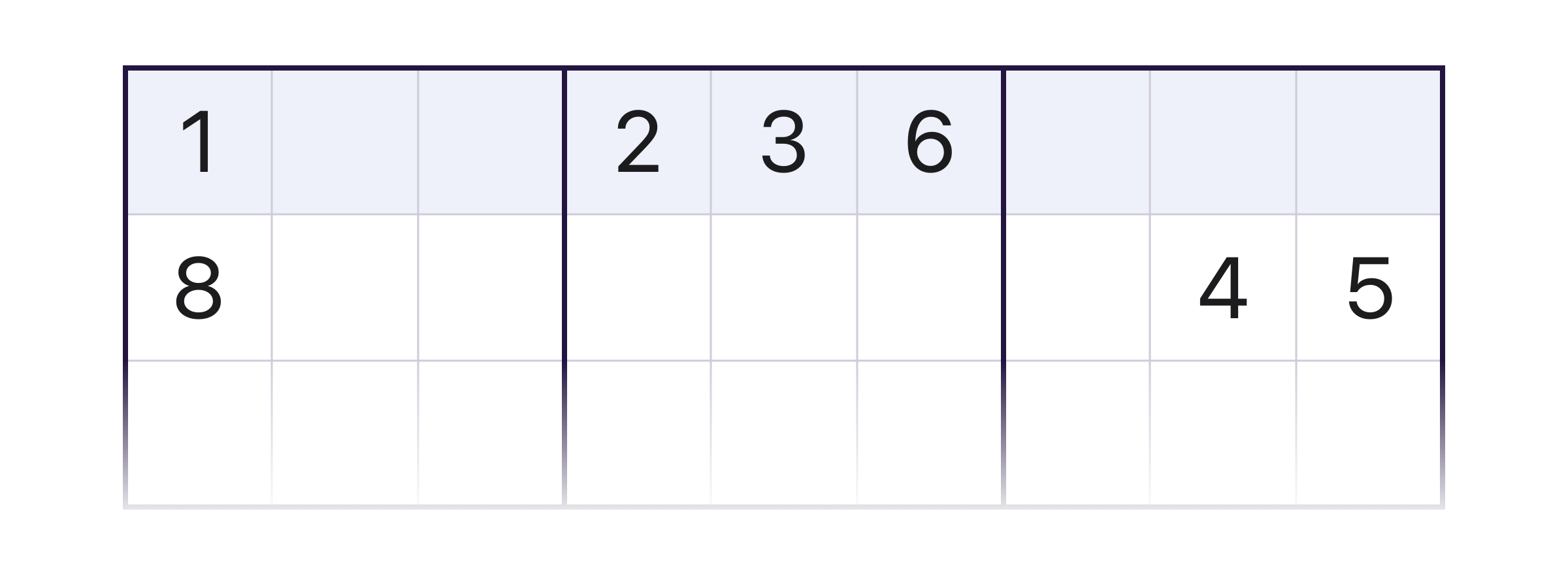
An example. The top row is as shown in the following drawing: 1, empty, empty, 2, 3, 6, empty, empty, empty.
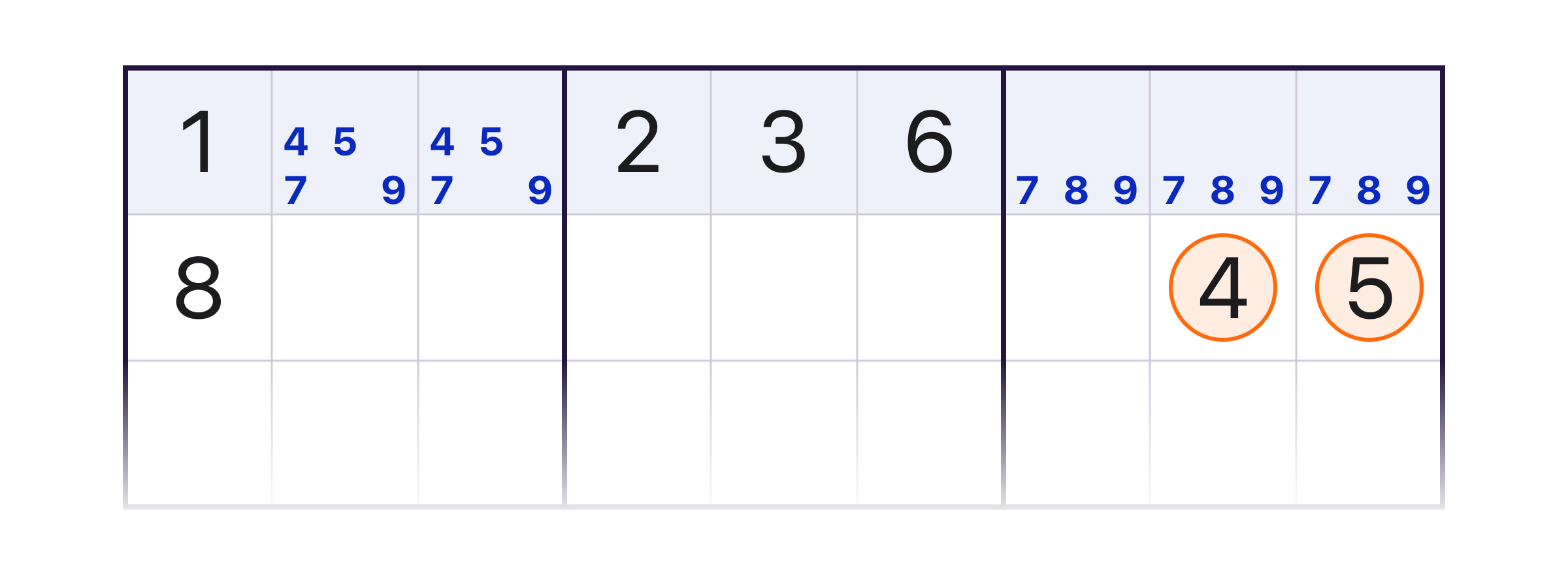
The missing digits are 4, 5, 7, 8 and 9. The top-right box already holds a 4 and a 5, so neither can go in the three cells on the right of the row. Now write in the pencil notes: the three cells on the right get only 7, 8 and 9, the second and third cells 4, 5, 7 and 9 (the 8 is missing because the top-left box already has one).
So in the first row, the 4 and the 5 appear only in the two cells in the first box. The pair is there; it’s just hiding beside the 7 and the 9 — hence the name. If the 4 and the 5 both have to go into these two cells, the cells are taken. Remove the 7 and the 9, and both cells hold only 4 and 5.
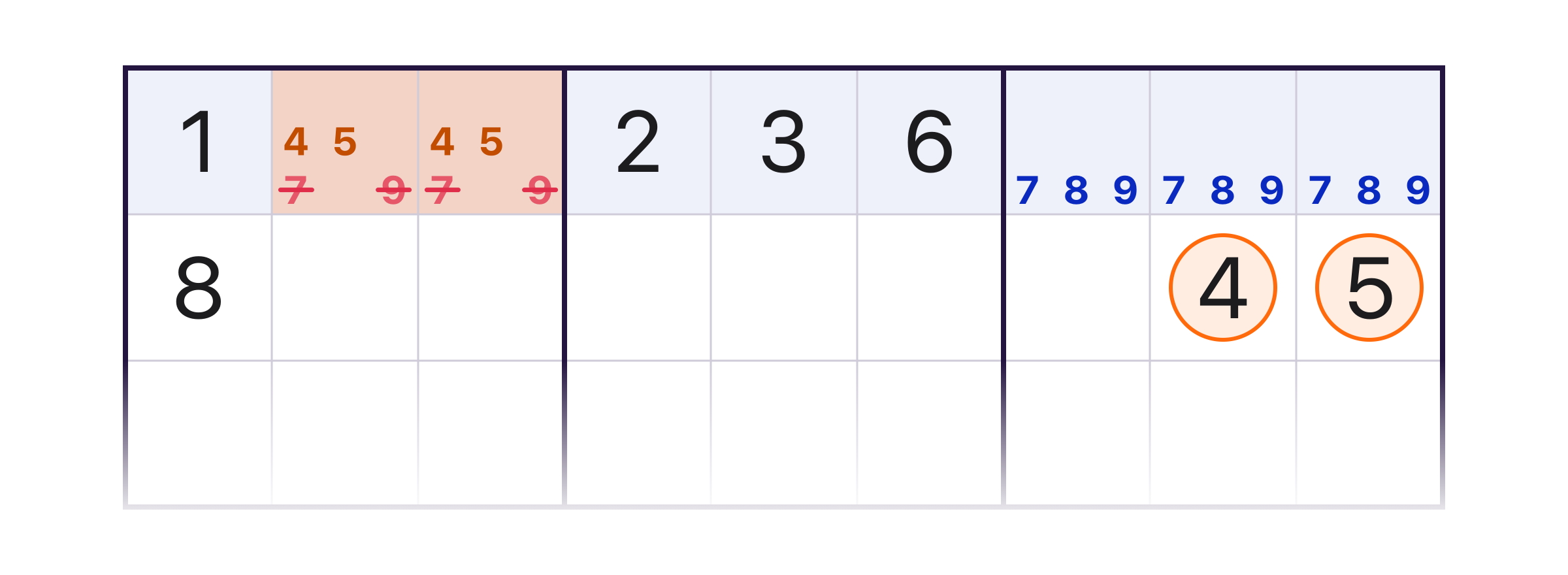
Hidden and naked. You may already know the Naked Pair: two cells that hold only the same two notes. That one stands out at once. The Hidden Pair is the same idea seen from the other side, just like the singles: the naked kind asks what a cell can still be, the hidden kind asks where a digit can still go. Once you’ve removed the extra notes, the hidden pair becomes a naked one, and that often leads straight to the next step. In the example, both cells also sit in the same box — so you can remove the 4 and the 5 from every other cell of the top-left box.
How to find it. Pick a row, column or box with lots of notes, and for each digit that appears as a note, ask: how many cells is it still in? If it’s in only one, that’s a Hidden Single — enter it as the answer right away. If it’s in exactly two, remember those two cells. If you find a second digit in exactly the same two cells, you have your pair. Digits with three or more possible places can be skipped for this technique.
Where you’ll meet it. On Medium, the Hidden Pair is the hardest technique a puzzle can ask for. Puzzles at this level are chosen so that they need at least one pair, naked or hidden. On Hard and Expert, you may meet it again as one step among many.
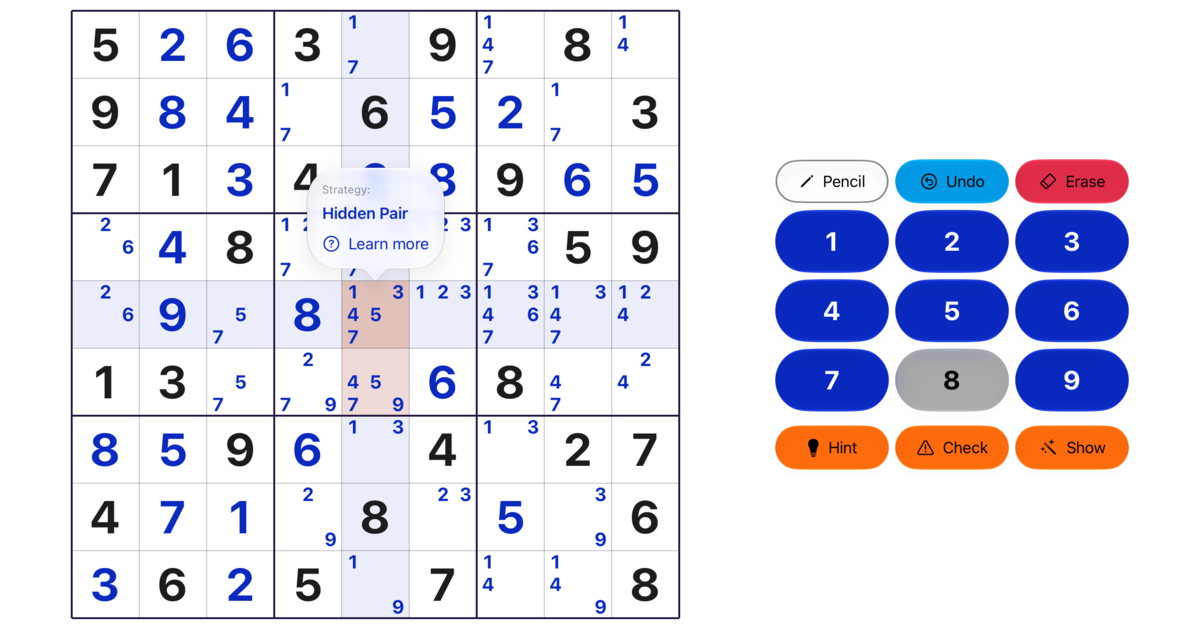
If you can’t find it, Hint shows you. Tap Hint, and the app highlights both cells of the pair. A small callout next to them names the technique, with “Learn more” leading to the explanation in Help. Hint doesn’t change your notes — removing them is up to you. If you’ve already removed the extra notes, Hint skips the pair and goes straight to the next step. Both are on by default: “Complete hint” highlights both cells, and “Show hint strategy” names the technique. If you’d rather search yourself, turn one or both off in Settings.
The Hidden Pair takes no trick, just a different question. Instead of “What fits in this cell?”, you ask “Where can these two digits still go?” If the answer is the same two cells for both, you’ve found it.
Further reading
- Solving strategies in the Sudoku help — every technique the app uses, from the Naked Single to Forcing Chains, in the order you’ll need them.
- SudokuWiki.org: Hidden Candidates — Andrew Stuart’s worked examples for hidden pairs, triples and quads.
- HoDoKu: Hidden Subsets — short and precise, with a section on how to find them.
- Wikipedia: Glossary of sudoku — a one-line definition next to the other terms used in solving.
Get it
Sudoku is free on the App Store, with no ads and no tracking. Tap the badge below to install it.
